'An Old Cannibal Story', Rediscovered After 142 Years
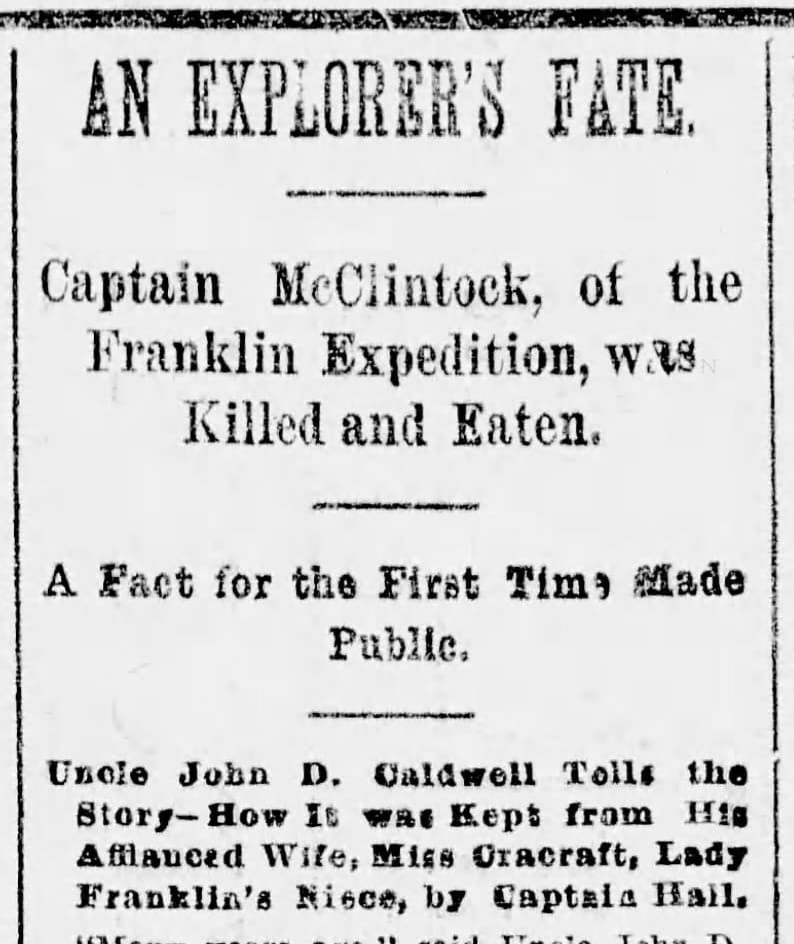
A wave of newspaper articles from 1884 preserves what Charles Francis Hall learned about Franklin's men. Nothing like it appears in any other source.
Some mysteries thin over time. Not Franklin.
Since late July 1845, when whalers last saw Sir John Franklin and his 129 men anchored to an iceberg in Baffin Bay, new people have continually been drawn to unraveling what happened next to this ill-fated group of explorers. In all the speculation that exists, one theory has remained buried - that the cannibalism was pre-planned and a unanimous decision was made amongst the men to select one of their own to be eaten.
The story originated from Charles Francis Hall, one of the first people to be consumed with the search for Franklin. A Cincinnati businessman, he sold his newspaper in 1860 and spent roughly seven of the next 10 years in the Arctic chasing down leads, stories, and artifacts related to Franklin's men.
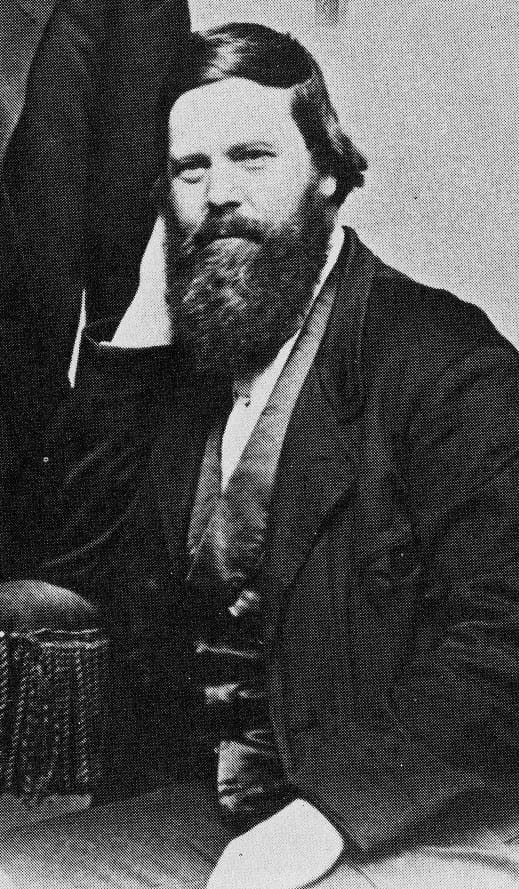
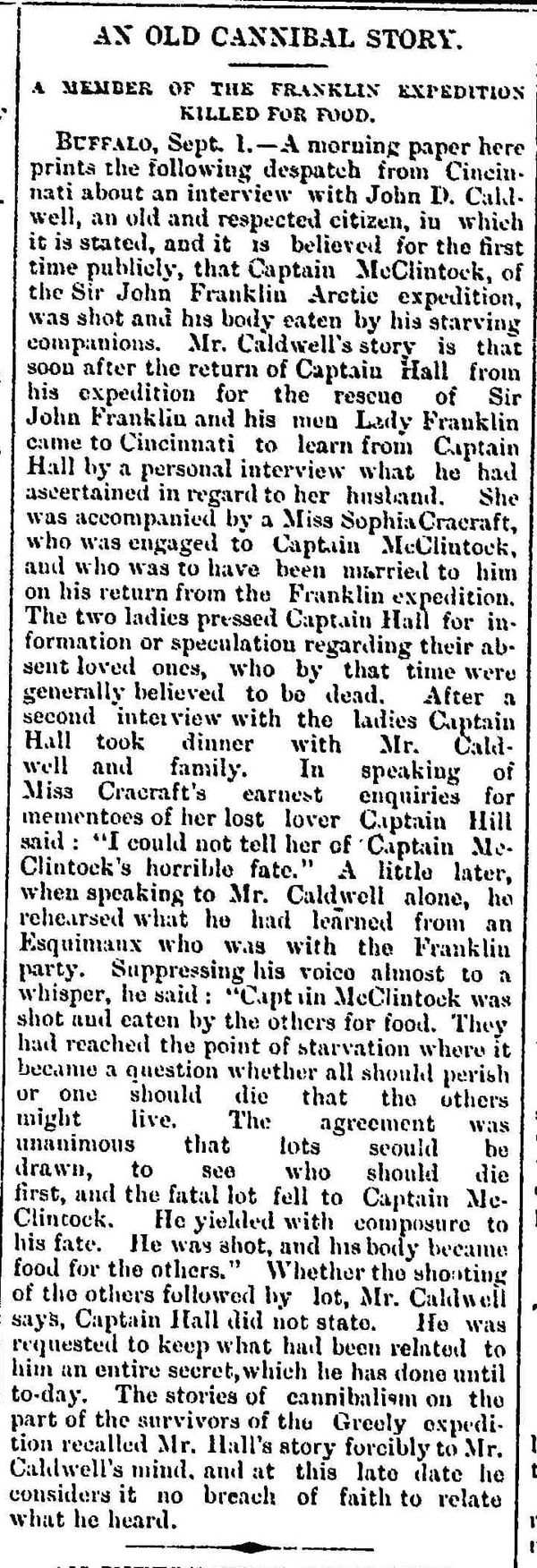
The article first appeared in the Cincinnati Evening Post on August 30, 1884. It was based on an interview with John D. Caldwell, a Cincinnati civic figure. 14 years earlier, at a private dinner between the two men while Lady Franklin was visiting Cincinnati, Hall had told him what an Inuit witness had said about the death of a Franklin officer:
Capt. McClintock was shot and eaten by the others for food. They had reached the point of starvation when it became a question whether all should perish or one or another should die that the others might live. The agreement was unanimous that lots should be drawn to see who should die first, and that lot fell to Capt. McClintock. He yielded with composure to his fate. He was shot, and his body became food for the others.1
For those familiar with the Franklin expedition, the error in this statement will be obvious. McClintock wasn't on the Franklin expedition; he was the searcher who came home in 1859 and lived another 48 years after the date of the Cincinnati dinner. Caldwell will later address this error in his recollection of the conversation.
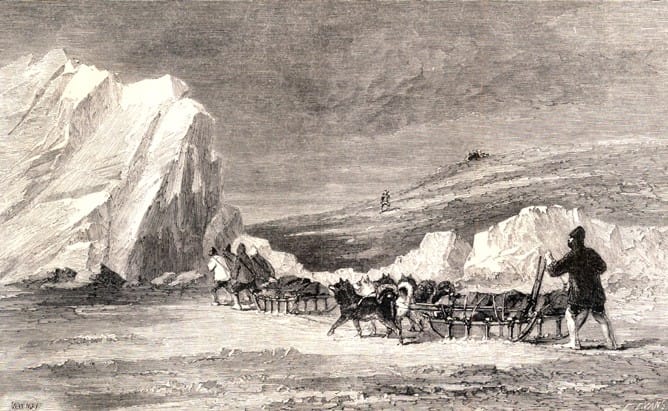
Looking past the identification error, two other claims from the conversation jump out:
- An "Esquimaux who had been with the Franklin party" was Hall's source
- Pre-planned cannibalism: "the agreement was unanimous that lots should be drawn to see who should die first"
Neither of these claims appear in the standard reconstructions, modern biographies, or literature on the Inuit-testimony. Even the recent forensic study of the Erebus Bay remains (Stenton, 2015) outlines the cut marks as "end-stage cannibalism", being the opportunistic defleshing of bodies already dead, not the active killing of a chosen man.
Whether either is true is a question this article alone cannot answer.
However, in a 170-year-old search plagued by a lack of information, any piece of evidence deserves to have some attention. Especially one that comes from Charles Francis Hall's "warm friend," was shared in a setting where Hall spoke more freely than he did anywhere in print, and is retold the month after another cannibalism headline had recalled the story to Caldwell's mind.
Before we walk through the story from the original newspaper articles, let's introduce the one name most Franklin readers will not be familiar with.
Who was Caldwell?
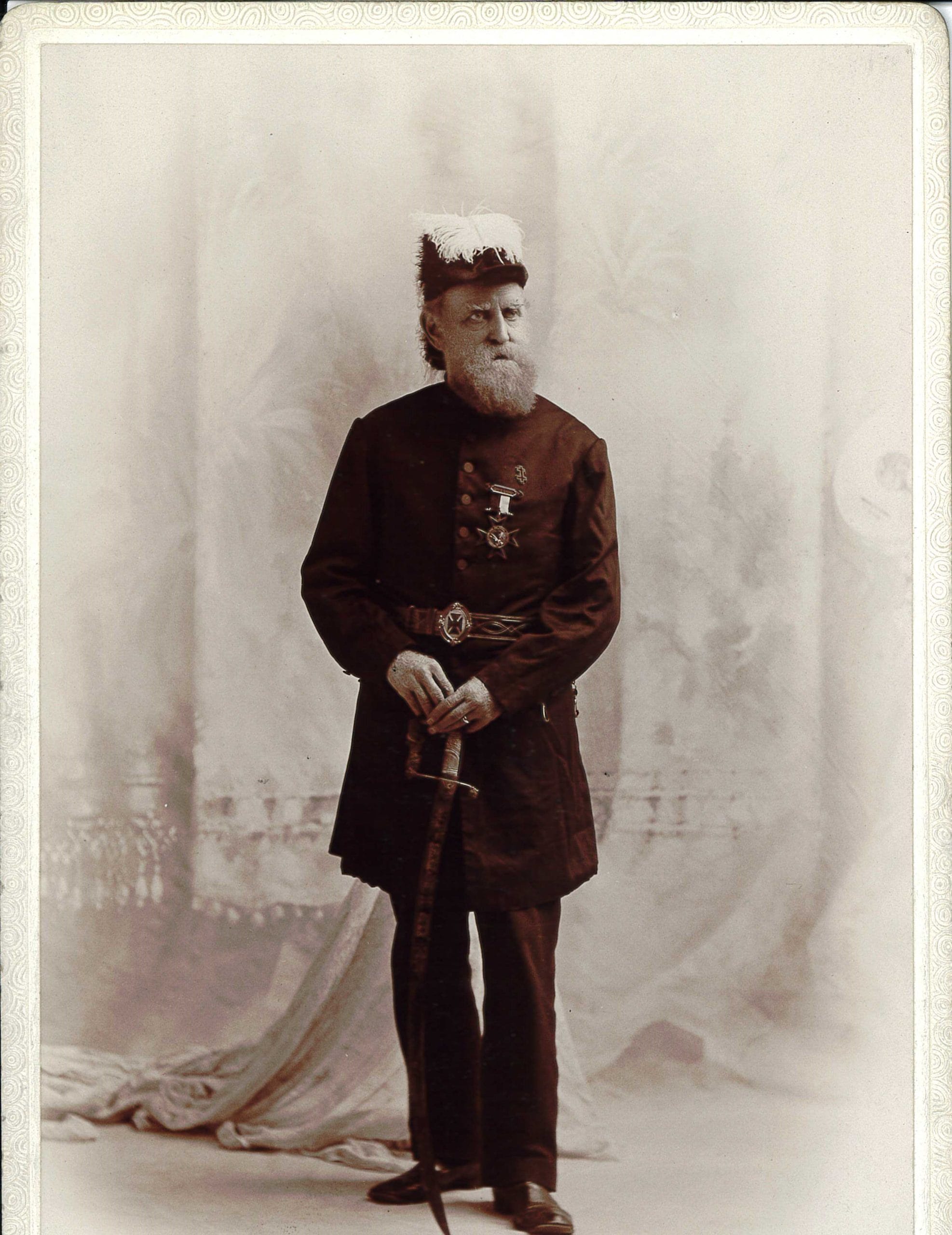
John Day Caldwell was 67 years old in August 1884 when he gave the interview. A longtime Cincinnati civic figure, he was an ex-member of the Cincinnati Board of Public Works, the publisher of a historical periodical that ran from 1873 to 1885, and had earlier worked at the Cincinnati Gazette. His hometown Cincinnati Post described him as a man of "sterling integrity even an enemy cannot be found to question."
Caldwell was also Hall's old editorial colleague. From 1858 to 1860, the two worked together at Hall's newspaper, the Cincinnati Occasional and the Cincinnati Daily Press. As Caldwell put it in 1884: "We were engaged together upon the little penny paper which he then published in Cincinnati, and were warm friends"2. When Hall sold his paper in early 1860 for what would be his first Arctic expedition, their professional relationship ended but the two stayed friends.
Lady Franklin, 1870
Sir John Franklin's widow, Lady Franklin, had spent 25 years and most of her private fortune trying to find out what happened to her husband. By the summer of 1870, at nearly 80, she had been travelling five months. She had crossed the Straits of Magellan by steamer, and then from San Francisco sailed up to Sitka in Alaska and back. She arrived in Cincinnati on a railway that had not existed when her husband had sailed.
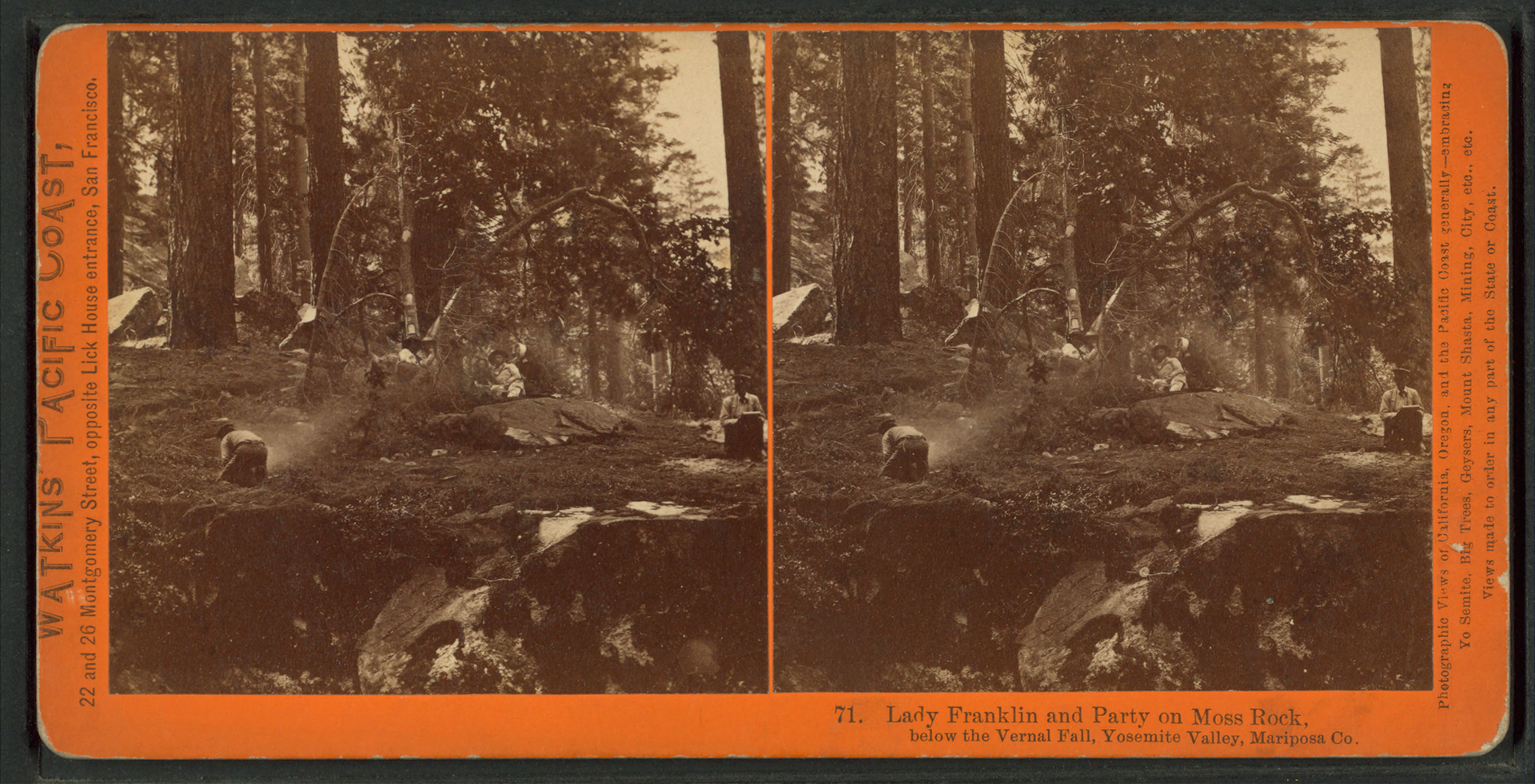
Her own journals do not record her visit to Hall in Cincinnati. Her biographer Frances Woodward, working from inside the surviving archive, put it this way: "Oddly enough, the grand object of their visit to America is given no record in these journals" (Portrait of Jane, 1951, ch. XII). The 1870 press, her pre-trip correspondence, and the route itself all converge on the same answer: she had come to meet Hall, and to hear directly what no other living man could tell her about her husband's fate.
The New-York Daily Tribune of 28 July 1870, reprinting the Cincinnati coverage, was explicit about what Lady Franklin was seeking from Hall:
Her object in coming to Cincinnati was to meet Capt. C. F. Hall, the famous Arctic explorer of this city, who is at home preparing for another Arctic voyage. She wanted to meet him, and hear from his own lips about the traces of her husband that he had found, after the expeditions she had fitted out had made their reports. She wanted to hear, too, many of the minor, and to others uninteresting, details of his travels and discoveries, that he has never had an opportunity to publish.3
Travelling with Lady Franklin was her 54-year-old niece, Sophia Cracroft, who had her own tie to the lost men. Before the expedition sailed in 1845, Francis Crozier, captain of HMS Terror, had asked Sophia Cracroft to marry him.
While the recent reconstruction of events is more nuanced, the 1884 press framed the relationship as a formal engagement describing Cracroft as "a sad-eyed, heavy-hearted girl who weighed every word uttered by Capt. Hall, apparently in expectation of some revelation, some slight circumstance on which to hang a hope that her lover still lived"1.
When Lady Franklin and Cracroft arrived in Cincinnati, Hall and Caldwell co-organized the civic reception and were their hosts. The Cincinnati Daily Enquirer reported the movements of their "honoured guest"4:
Yesterday, after church, Lady Franklin and Miss Cracroft, under the escort of Captain C. F. Hall and Mr. J. [D.] Caldwell, were driven to Spring Grove, which Lady F. enthusiastically said was finer than any city of the dead in England, the most beautiful cemetery, in fact, she had ever seen. She was surprised, too, at the evidences of wealth and culture afforded by the countless monuments.4
Cincinnati, Late July 1870
Newspaper articles indicate Lady Franklin and Cracroft spent over three days in Cincinnati, where they had at least two private interviews with Hall. The Cincinnati Daily Enquirer summarized that Lady Franklin had "learned from the lips of Captain Hall facts of priceless value to her, and of which no other living man could so well have told her"4.
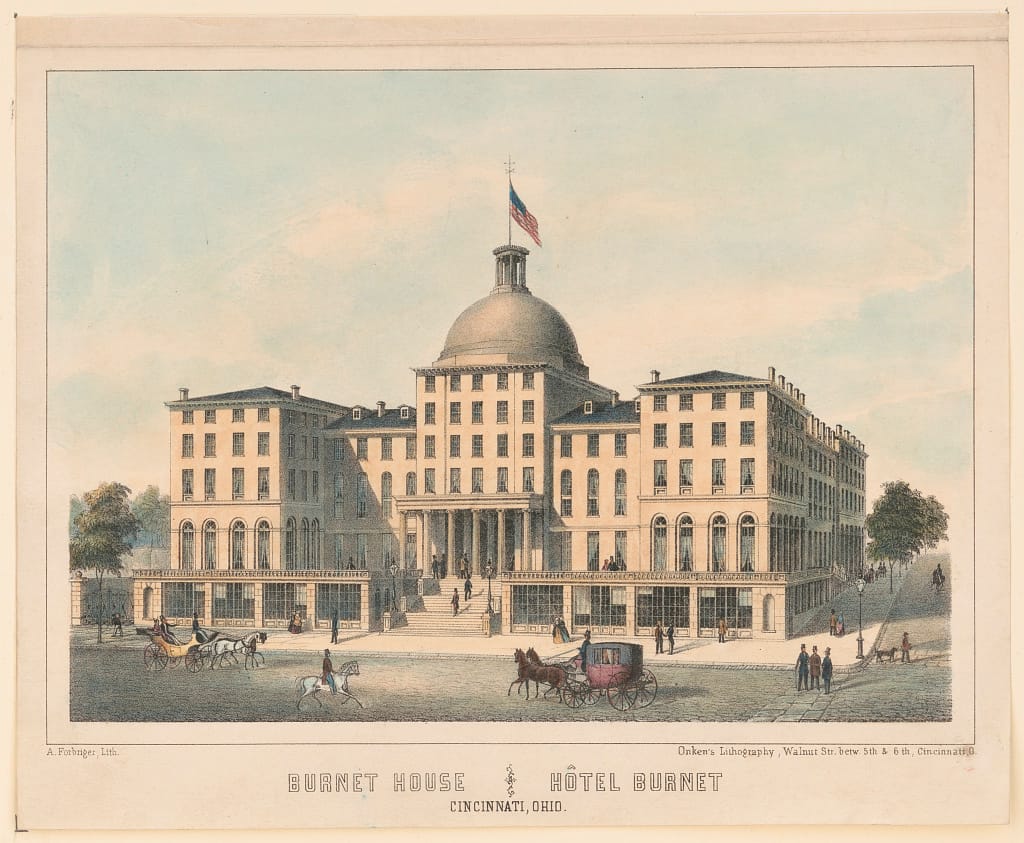
But Hall had not told her everything. At a private dinner at Caldwell's house, Hall was "relating the substance of his interviews with the ladies"1, running through the stories he heard and the mementos he had collected, when he stopped. There was one fact he could not tell them, he said to Caldwell, one he dared not tell the world.
Hall dropped his voice to a whisper.
"I couldn't, I couldn't tell her of CAPT. M'CLINTOCK'S HORRIBLE FATE."1
Then he gave Caldwell the substance of the Inuit witness's account: the unanimous decision, the lots drawn, the shot fired, the body eaten.
Caldwell kept it a secret for 14 years.
Within a week the story had reached at least 38 other newspapers across 16 states, from Georgia to New York, plus reprint in Montreal and Winnipeg8.
Why now (1884)?
That summer, another cannibalism story dominated American headlines. Six men had been rescued off Cape Sabine after 25 men had been sent by the American Army in 1881. On August 12, the New York Times led with: "HORRORS OF CAPE SABINE. Terrible Story of Greely's Dreary Camp. Brave Men, Crazed by Starvation and Bitter Cold, Feeding on the Dead Bodies of their Comrades." Two days later, physicians exhumed Lieutenant Kislingbury's body at Mount Hope Cemetery in Rochester and signed a sworn statement: "the flesh was cut away with some sharp instrument" (Levy 2019, ch. 37). "SHAME OF A NATION," ran another. "PROOF FROM THE GRAVE" (Levy 2019, ch. 36).
These headlines pushed Hall's old secret to the front of Caldwell's mind. The Cincinnati Evening Post article puts it plainly: "The fate of the Greely expedition recalled it to his mind, and he considered that after this lapse of time it could do no harm to tell the sad story"1.
Washington, September 2, 1884
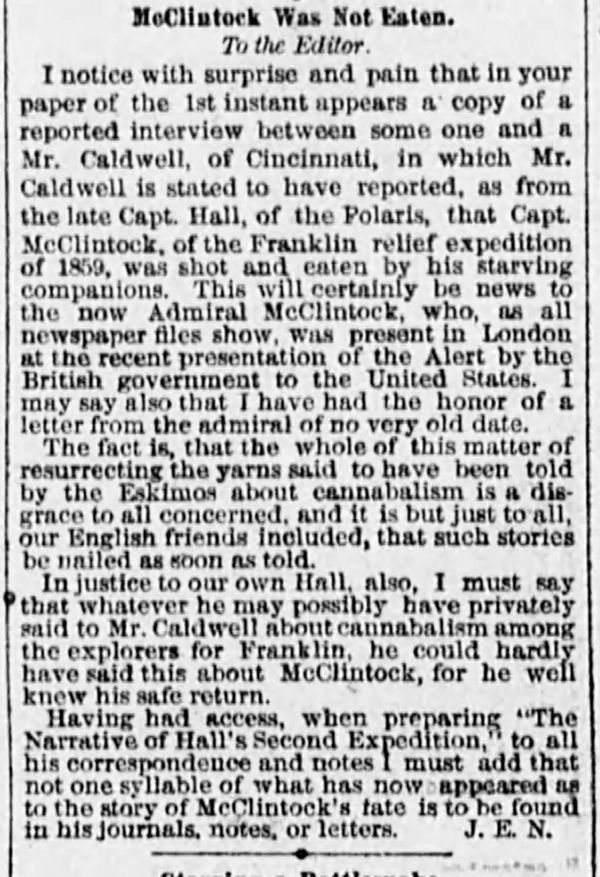
By September 2, two rebuttals appeared in Washington newspapers. The Washington National Republican ran a rebuttal by Joseph Everett Nourse, the posthumous editor of Hall's journals:
This will certainly be news to the now Admiral McClintock; who, as all newspaper files show, was present in London at the recent presentation of the Alert by the British Government to the United States.5
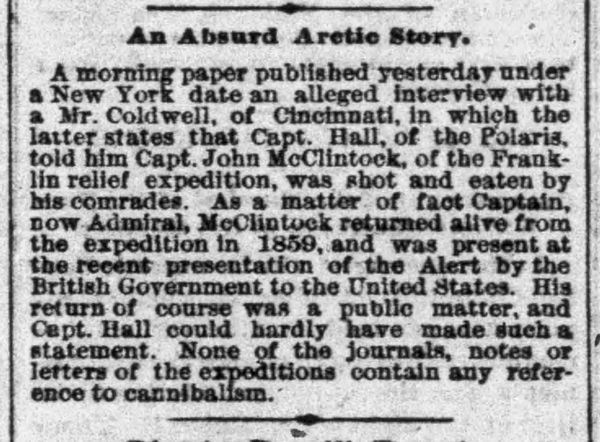
"An Absurd Arctic Story" ran in the Washington Post that same morning, echoing Nourse's argument to a tee.
Both pieces end on the same point: "None of the journals, notes or letters of the expeditions contain any reference to cannibalism"6. Nourse had just edited the second posthumous edition of Hall's papers when he made that claim.
Caldwell's Clarification, September 4, 1884
Five days after the original article, Caldwell acknowledged the error directly, stating that "the name was given as a hasty recollection, and was wrong, of course, since Capt. McClintock was a member of an exploration party some seven years after that of Franklin's. His was a familiar name, and was unfortunately the first suggested to my mind"2. Later the same day, Caldwell called back at the newspaper with his best recollection:
"[H]e thinks that it was probably Captain Crozier"2.
Caldwell could not recall the name with certainty. It is the closest thing to a direct identification we have, and it carries the same problem as the first error. A 14-year-old memory under pressure from a reporter, possibly reaching for another famous Franklin name. Worth taking seriously, worth holding lightly.
In his follow-up, Caldwell adds detail on the "Esquimaux who had been with the Franklin party." The article explains that Hall had rescued an old Inuk man and his wife after which the couple became devoted to Hall. When Hall's feet froze, the woman warmed them in her bosom. The old man told Hall about the Franklin retreat from inside the experience:
the last of Franklin's party, to the number of about 40, died from starvation at a certain place, and he himself witnessed the first sacrifice of the officer, whatever his name might have been, under the compact to die by lot.2
Caldwell reflected: "I remember, too, that the inference I drew from his statement was that the contract to perish by lot was carried farther than the sacrifice of the officer he named, as the affianced husband of Miss Cracraft [sic], and that others of the party met the same fate."
On Caldwell's reading, what Hall told him in 1870 was not a single killing. It was the first of a series.
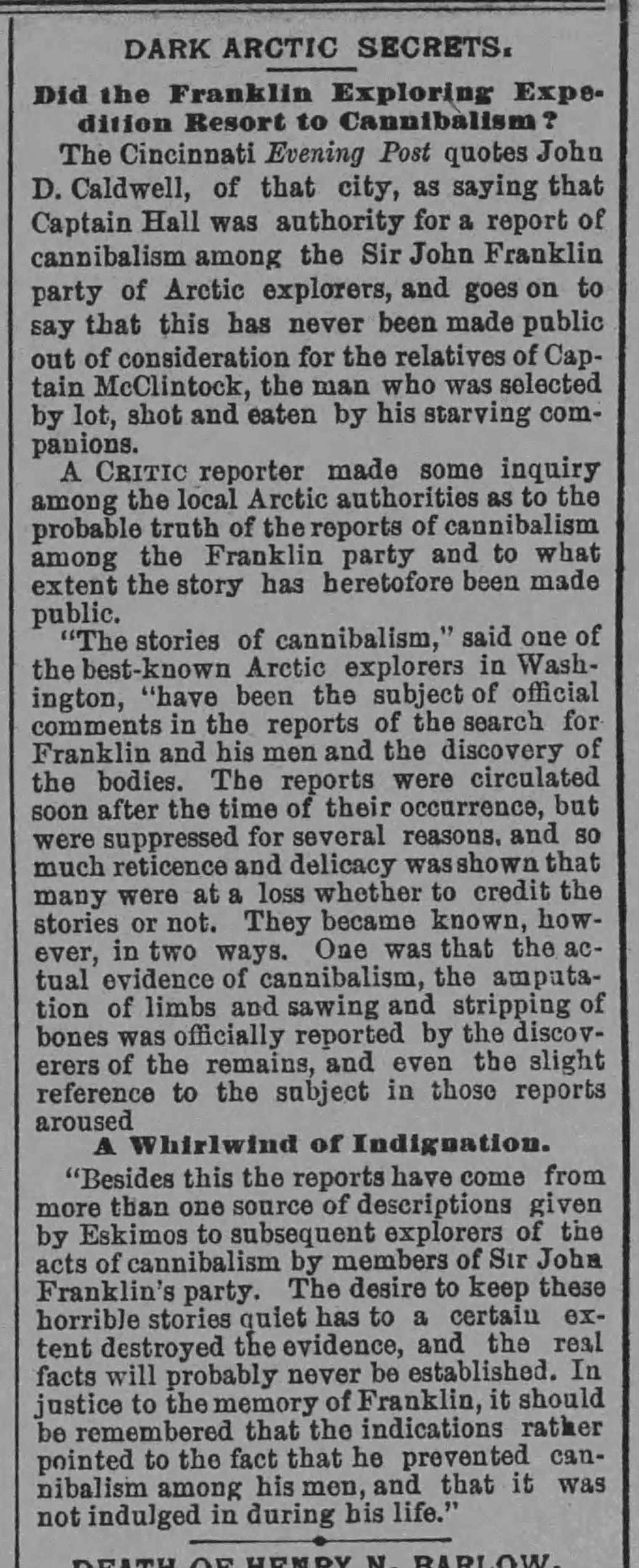
Dark Arctic Secrets
Not every voice in 1884 dismissed the story. Two days after the original article ran, Washington's Evening Critic sent a reporter to see what the city's Arctic community knew. The unnamed "best-known Arctic explorer in Washington"7 they interviewed confirmed Caldwell's underlying claim. He told the reporter that two independent lines of evidence for cannibalism among Franklin's men existed and had been documented officially: physical evidence ("the amputation of limbs and sawing and stripping of bones"7), and Inuit oral testimony collected by Hall and other subsequent explorers. Both, he said, had been suppressed.
The headline the Evening Critic gave the reporter's findings was "Dark Arctic Secrets" and ended by stating,
The desire to keep these horrible stories quiet has to a certain extent destroyed the evidence, and the real facts will probably never be established. In justice to the memory of Franklin, it should be remembered that the indications rather pointed to the fact that he prevented cannibalism among his men, and that it was not indulged in during his life.7
Some mysteries thin over time. This horrible story nearly did.
What other Dark Arctic Secrets are waiting to be uncovered?