Portrait of Lady Franklin - A Visit to America
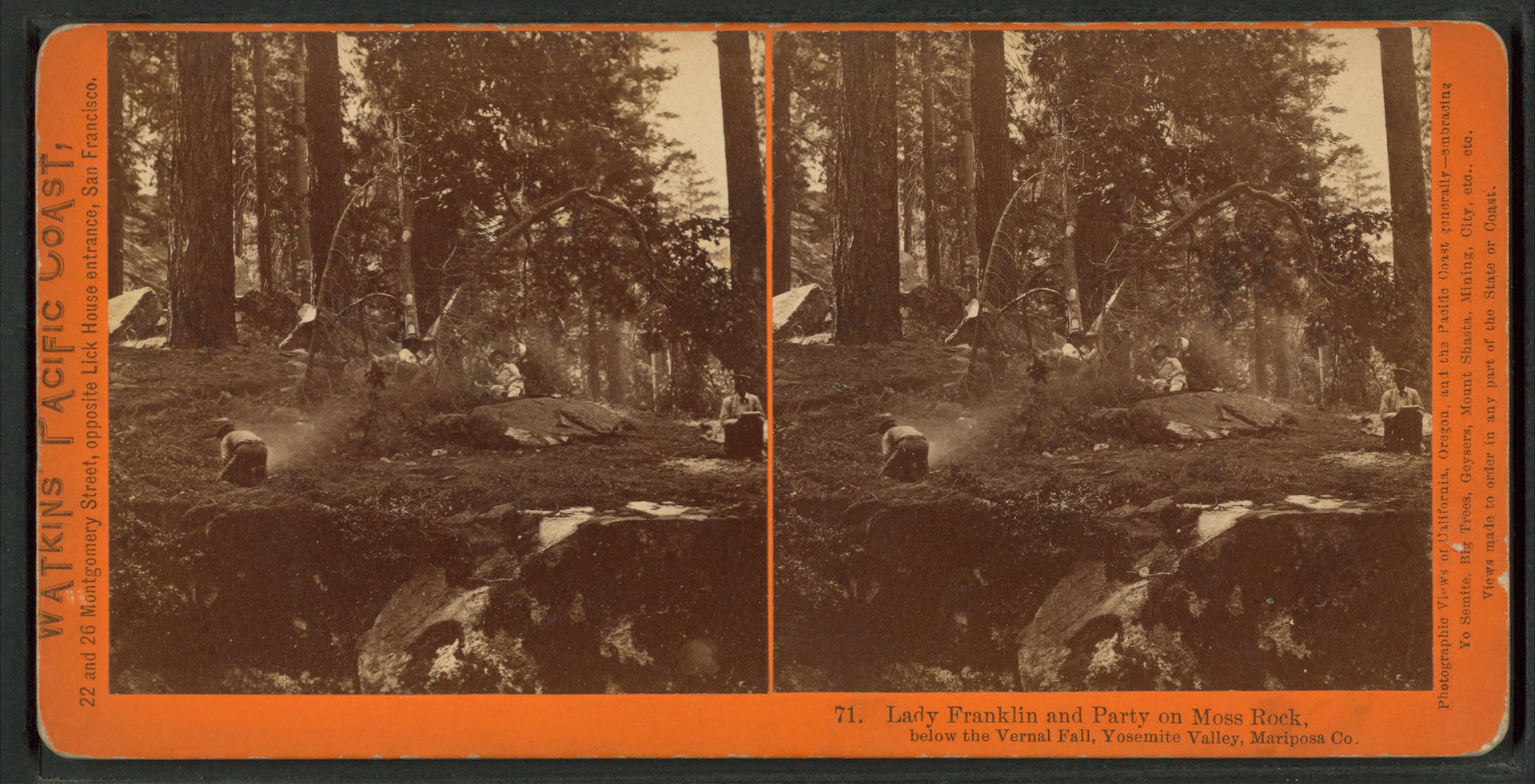
A portrait of Lady Franklin from the 1870 American newspapers.
By the time Lady Franklin visited the one Cincinnati man who had answers, she had spent 25 years piecing together what had happened to her husband’s expedition. No record of it survives in her journals. Her biographer, Frances Woodward, who had Lady Franklin’s journals, put it plainly: “It is known only from subsequent correspondence and the press that Jane met Hall in Cincinnati in July and at Mr. Grinnell’s house in August…” (Portrait of Jane, 1951). Russell Potter, taking Woodward’s hint, confirmed the Cincinnati meeting and identified a date for the New York meeting.
Reading Potter’s blog earlier this year had me curious about what else might be learned from Woodward’s ‘subsequent correspondence and the press.’ The 1870 American newspapers drew their own portrait of Lady Franklin: from arrival and departure dates to firsthand accounts of the visit, including the wig she wore, who she met, and what she told a room of autograph-seekers about her age.
Coming to Cincinnati
An October 1869 letter shows Lady Franklin ‘perplexed and anxious’ about what Hall had found, wishing to be in New York to question him. The New-York Daily Tribune on July 28, 1870 was explicit about what she was seeking:
Her object in coming to Cincinnati was to meet Capt. C. F. Hall, the famous Arctic explorer of this city, who is at home preparing for another Arctic voyage. She wanted to meet him, and hear from his own lips about the traces of her husband that he had found, after the expeditions she had fitted out had made their reports. She wanted to hear, too, many of the minor, and to others uninteresting, details of his travels and discoveries, that he has never had an opportunity to publish.
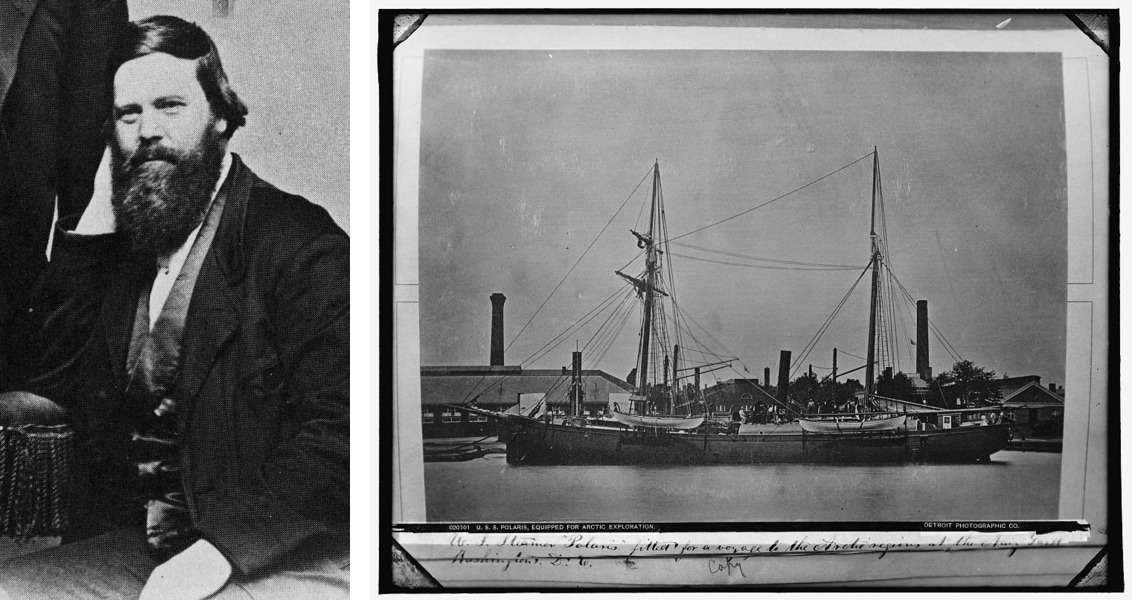
Charles Francis Hall, the only known photograph, c.1870 (photographer unknown, public domain). USS Polaris at Washington Navy Yard (Library of Congress, det-4a13983). Hall departed on the Polaris on July 3, 1871, and died at Thank God Harbor on November 8.
Travelling to America was not Lady Franklin’s first choice. She offered to pay Hall for his time and expenses if he would visit her in London, but Hall declined, as he was consumed with polar-expedition preparations. As he would not travel to London, Lady Franklin and her niece Sophia Cracroft set out to meet him in America. Cracroft had travelled with her for twenty years.
They left England in January 1870 and arrived in San Francisco on April 13. They stayed nearly three months on the Pacific coast while Hall competed for command of the North Pole expedition. Cracroft, writing home, explained why they waited: “There is no object in crossing to N.York yet, because Hall is moving heaven & earth to get the command of an expedn to reach the North Pole… Until that point is settled, it is of no use attempting to see him.” During the wait, they sailed to Sitka aboard the USS Newbern. They were stranded there nearly five weeks, unable to find transport south.
Cincinnati: July 23 to 25
When Lady Franklin arrived in Cincinnati on July 23, Hall was on the platform at half past six in the morning. He would spend the next three days at their side. Lady Franklin ‘was waited upon by the officers of the city, of the Chamber of Commerce and by citizens generally, all of whom, despite her advanced age, she received with an ease that marked her as a lady born.’
The Herald reported that she spent ’the day in retirement, resting from the fatigues of her long journey.’ That evening, Hall drove her and Cracroft to Clifton, where Henry Probasco entertained them at the most prominent private residence in Cincinnati.
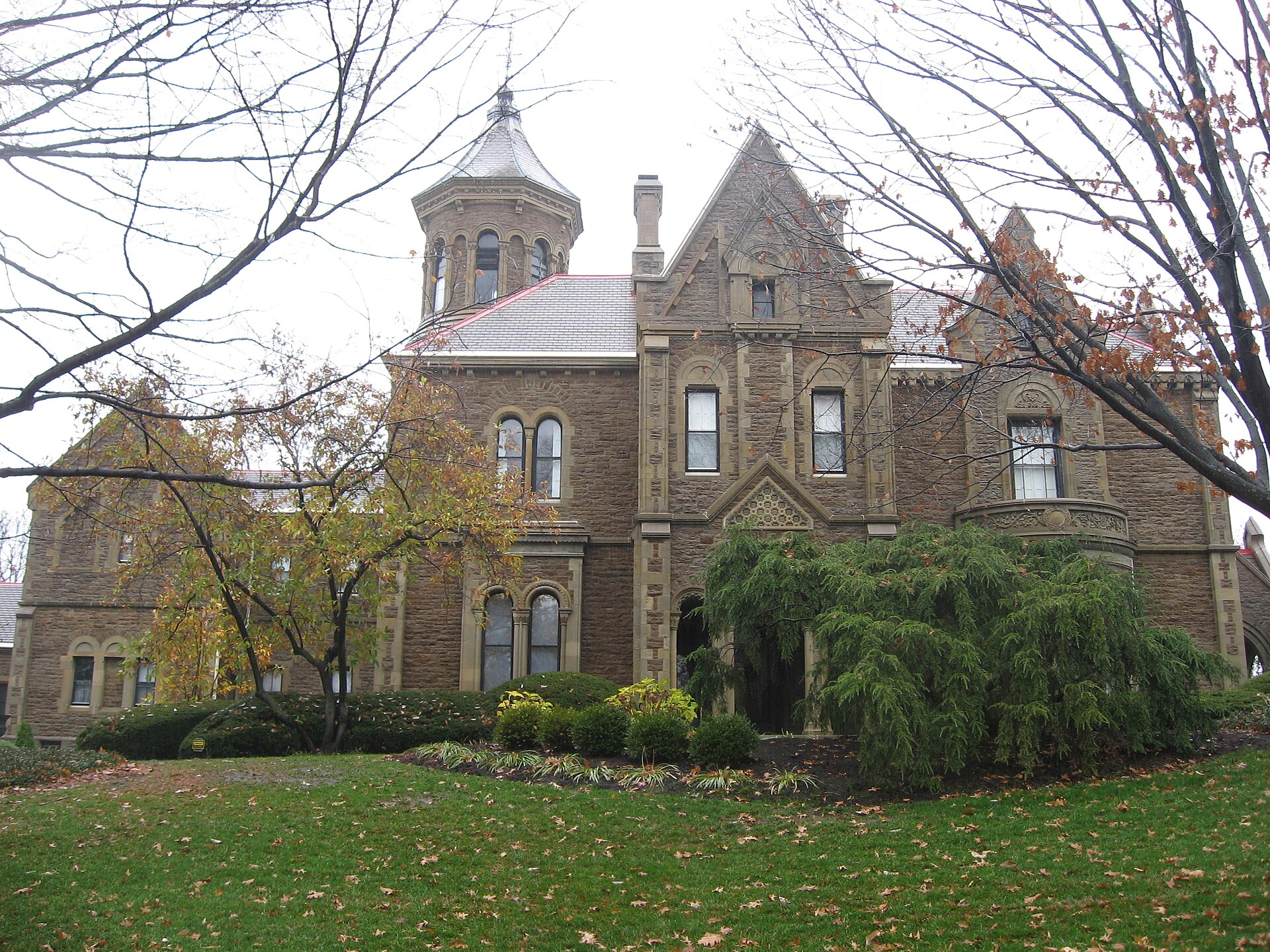
Oakwood, the Henry Probasco House, Clifton, Cincinnati. Norman Romanesque Revival, designed by William Tinsley, built 1859 to 1865. In July 1870, the most prominent private residence in Cincinnati. Photograph by Nyttend, 2010. Wikimedia Commons (public domain).
Probasco was Director of Spring Grove Cemetery, their first stop on Sunday. After church, Hall and John Day Caldwell took Lady Franklin and Cracroft on a carriage tour of the city. Caldwell was Hall’s old newspaper colleague; the two had worked together on the penny paper Hall published in Cincinnati before his first Arctic expedition. Lady Franklin called Spring Grove “finer than any city of the dead in England, the most beautiful cemetery, in fact, she had ever seen.”
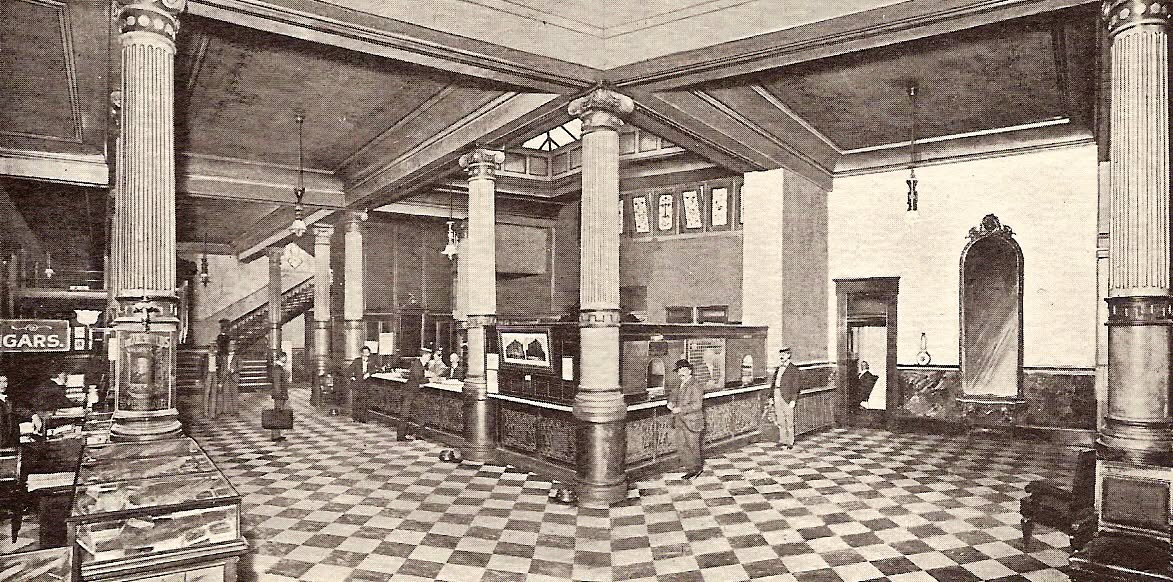
The lobby of the Burnet House hotel, Cincinnati, where Lady Franklin stayed during her July 1870 visit. Photograph, undated. Source unknown.
On Monday afternoon, as announced, Lady Franklin received the public in the main parlor of the Burnet House between three and four o’clock. She worked through several hundred autograph requests, ‘seeming amused at the turn affairs had taken, but willingly acceding to all requests.’ The Commercial’s reporter noted she had ’turned of seventy,’ as she herself expresses it. She was 78.
Lady Franklin was not the figure some had imagined:
There were those who expected to see a tall, dignified, old lady, with silvered hair. Instead they saw a medium-sized gentlewoman, in cap and dark-brown wig, dressed in black silk skirt and cool, loose jacket of white linen, trimmed with black lace.
The same reporter offered a different portrait: ‘a full, square face, with good features — the face of a well-bred, intelligent, and kind-hearted lady — and at the same time a strong English face.’ Cracroft seemed “fat, fair and forty.” She was 54.
The summary of what Lady Franklin took from the visit: “During the drive, and during her stay in Cincinnati, Lady Franklin has learned from the lips of Captain Hall facts of priceless value to her, and of which no other living man could so well have told her.”
After the reception, the party crossed the suspension bridge to Covington to call the family of President Grant.
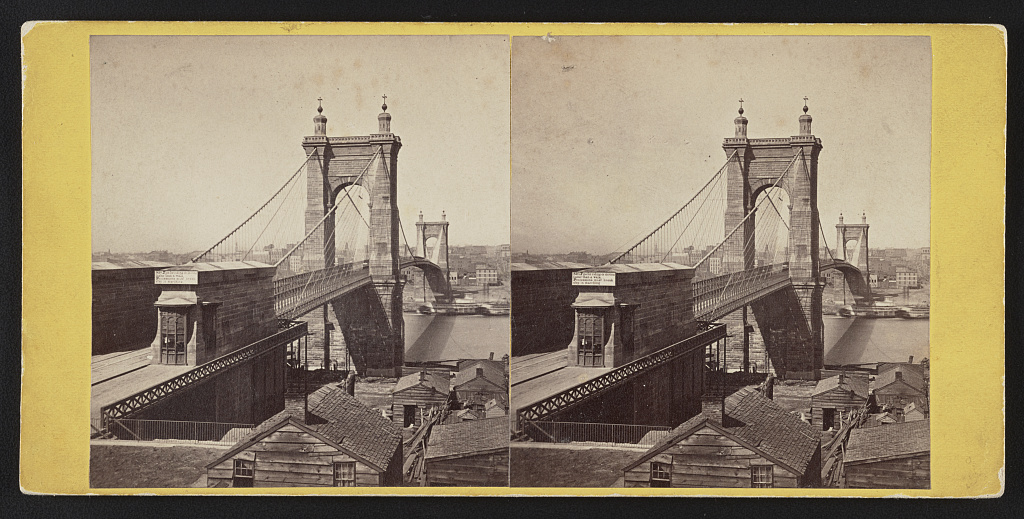
The Roebling Suspension Bridge from the Covington side of the Ohio River. Lady Franklin’s party crossed this bridge after the Monday reception to call on the Grant family in Kentucky. Stereograph by E. Mendenhall, c.1866-1880. Library of Congress, item 2015646063.
On September 2, 1870, weeks after Lady Franklin had sailed for England, words she had apparently spoken to Mrs. Grant were published:
Sir John is older than I, and I am near my end. He could not have lived in those frigid regions until now. The mystic North-west Passage will be his monument. Every-where during my American tour, your people have showered me with kindness, and I will return to old England, like Lafayette, with recollections only of a nation’s benedictions.
Escorted by Hall and Caldwell, the ladies left that evening, stopping at Niagara Falls before reaching New York. “Captain Hall follows in a few days to begin preparations for his great expedition.”
After Cincinnati
The last documented meeting between Lady Franklin and Hall was on August 13 at Henry Grinnell’s house in New York. The New York Herald recorded her arrival: Lady Franklin reached Grinnell’s on Friday, July 29, at half past ten in the evening. Hall was already living there. What passed between them across those two weeks, no paper recorded.
Five months after the Cincinnati reception, on December 27, 1870, Hall lectured before the Long Island Historical Society. He described showing Lady Franklin ‘silver plate, forks, knives and spoons’ he had recovered from the wreck of one of Franklin’s ships.
When Lady Franklin visited him in Cincinnati last Fall, he showed her these relics. She examined them very intently, and laid some that bore a peculiar crest away by themselves. The crest was an eagle’s head, with laurel branches on each side. As she examined these she seemed much affected. At length he asked her to whom they belonged. She replied: “That is plate I purchased for Sir John a few days before he sailed and I got that crest of our family engraved upon it.”
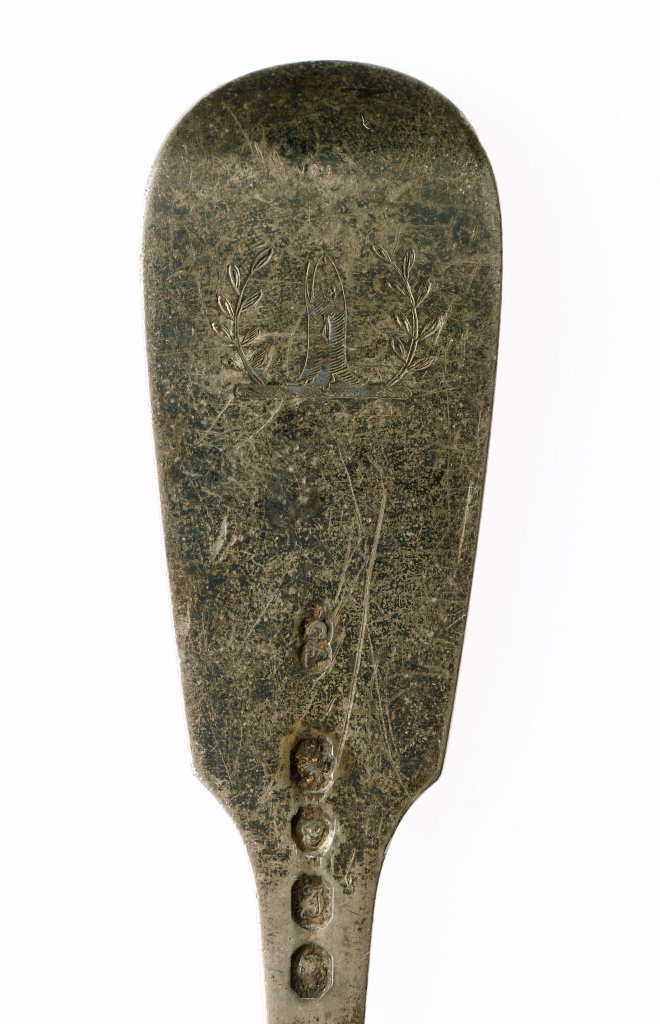
A silver table fork recovered from the Franklin expedition, bearing the Franklin family crest: a conger eel’s head between two branches. The Brooklyn Eagle’s ’eagle’s head’ is a reporter’s mishearing. Fiddle pattern, by George Adams, London, 1844-45. “W C” scratched on the back identifies its last user as William Closson, Able Seaman, HMS Erebus. National Maritime Museum, Greenwich, AAA2477. Copyright National Maritime Museum, Greenwich, London.
Lady Franklin’s journals gave a portrait of Jane. The newspapers gave a portrait of Lady Franklin.
Read the 1870 press yourself
- “Arrival of Lady Franklin.” — Cincinnati Daily Enquirer, April 14, 1870
- “Our Honored Guest. Movements of Lady Franklin Yesterday — Reception at the Burnet To-day.” — Cincinnati Daily Enquirer, July 25, 1870
- “Lady Franklin. Reception at the Burnet House Yesterday.” — Cincinnati Daily Enquirer, July 26, 1870
- “Lady Franklin. The Distinguished Lady in Cincinnati—She Meets Captain Hall, the Arctic Explorer—The Story of the Lost Sir John.” — New York Herald, July 27, 1870
- “Lady Franklin in Cincinnati.” — New-York Daily Tribune, July 28, 1870
- “Lady Franklin in the City.” — Richmond Dispatch, July 28, 1870
- “Lady Jane Franklin. The Widow of the Arctic Martyr in New York—Her Journey Round the World—Her Arrival at the House of Mr. Henry B. Grinnell.” — New York Daily Herald, July 31, 1870
- “Said Lady Franklin to Mrs. Grant” — Cincinnati Daily Enquirer, September 2, 1870
- “The Undiscovered Country. The Wonders of the North—How to Reach the Pole—Is It Land or Water?” — Brooklyn Eagle, December 28, 1870
Comments